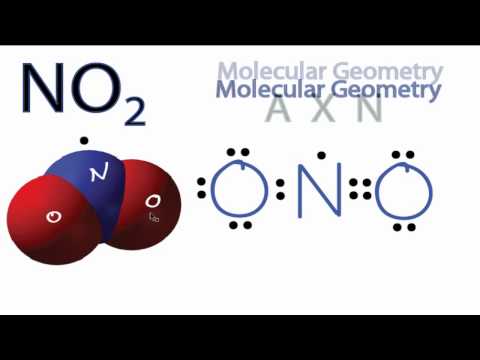
You know that feeling when you look at a cloud and suddenly it shapes into something totally random? Like, “Whoa, there’s an elephant!” or “Is that a pizza slice?” It’s like our brains just can’t help but connect dots.
Well, molecules are kinda like that too! They have shapes and personalities that tell us a lot about how they behave. Take nitrogen dioxide (NO2), for instance. It’s not just a regular dude hanging out; it has this cool bent shape that influences how it reacts with other molecules.
In this little chat about NO2 geometry, we’ll explore why its shape matters so much. We’ll dig into the world of molecular bonding and get to know these tiny guys better. Let’s get comfy and break down some science!
Understanding NO2 Molecular Geometry: Structure, Shape, and Implications in Chemistry
Understanding the molecular geometry of NO₂ (Nitrogen Dioxide) can feel a bit tricky, but it’s actually pretty cool once you break it down. So, what’s the deal with NO₂? First off, this molecule has a unique shape and structure because of how its atoms bond together.
Structure: Nitrogen is the central atom in NO₂, bonded to two oxygen atoms. But here’s where it gets interesting: nitrogen has five electrons in its outer shell. When it forms bonds with oxygen, it shares some of these electrons, creating a total of three bonds—one double bond with one oxygen atom and a single bond with the other.
Now, because one oxygen is double-bonded and the other is single-bonded to nitrogen, there’s something called a resonance structure going on. Basically, this means there are different ways to arrange those electrons that still lead to the same overall structure. This gives NO₂ some flexibility but also affects how we visualize its shape.
Once we picture those bonds, it’s clear NO₂ isn’t just a straightforward linear molecule. Instead, it adopts a bent shape. Why? Well, it’s all about electron repulsion! The lone pair of electrons left behind on nitrogen pushes down on the bonding pairs between nitrogen and oxygen. This push makes the angle between those bonds about 120 degrees—pretty neat!
Shape: So now that we have our bent shape in mind, let’s talk implications! The bent geometry influences how NO₂ behaves chemically. For example:
- Reactivity: Its shape makes it more reactive compared to linear molecules.
- Toxicity: It’s known for being a harmful pollutant in our atmosphere.
- Polar Molecule: This bent shape leads to an uneven distribution of charge within the molecule.
Being polar means NO₂ can interact in specific ways with other substances—like dissolving well in water or forming acids when mixed with moisture in the air.
Let me share something personal here: I remember standing outside during a particularly smoggy day years ago and wondering what made that haze so thick. Later I learned about pollutants like NO₂ contributing to air quality issues—talk about eye-opening!
In summary, understanding the molecular geometry of NO₂ is more than just lab work; it helps explain real-world problems like air pollution and environmental health issues. You see how these tiny molecules can have big impacts? It’s pretty amazing how everything connects back to basic chemistry fundamentals!
Exploring the Molecular Geometry and Bond Angle of Nitrogen Dioxide (NO2)
So, let’s chat about nitrogen dioxide, or **NO2**. This little molecule is pretty fascinating because of its shape and the angles at which its atoms bond. You see, it doesn’t just look cool; its geometry affects how it behaves in different environments, which is super important in chemistry and the environment.
Now, when talking about molecular geometry, we’re really looking at how the atoms in a molecule are arranged in space. For **NO2**, it’s a great example of something called a **bent** shape (or V-shape). That’s like when you try to make a “V” with your hands—easy to imagine, right? This happens mainly because of the way the nitrogen atom bonds with the two oxygen atoms around it.
The important thing to remember is that nitrogen (N) has five valence electrons while oxygen (O) has six. When they form bonds, nitrogen shares some of its electrons with each oxygen atom. But here’s where it gets interesting: **NO2** has one unpaired electron on that nitrogen atom after forming bonds! This causes some repulsion between the bonded and unbonded electron pairs.
The bond angles in **NO2** are typically around 120 degrees. But since there’s this lone electron on nitrogen pulling things around, you might not find them being exactly 120 degrees all the time—kind of like how everyone interprets a movie differently! The repulsion from this unshared electron pair makes the angle slightly less than 120 degrees.
Here’s why all this matters. The shape influences properties like polarity and reactivity. Because **NO2** is bent, it’s polar; meaning one end has a slight positive charge while another end carries a slight negative charge. This polarity allows it to dissolve in water and react with other molecules more efficiently!
A quick story to illustrate: Imagine trying to fit into a crowded elevator where some people are standing oddly close together—it’s kind of uncomfortable! That’s similar to what happens with molecules. The arrangement can affect how they interact with everything else around them.
In summary:
- Geometry: NO2 has a bent shape.
- Bond Angles: Generally around 120 degrees but can vary.
- Polarity: The bent shape makes NO2 a polar molecule.
- Impact: Geometry affects reactivity and solubility in water.
So next time you think about molecules or get stuck in an elevator, remember that their shapes play an enormous role in how they behave! Isn’t science like connecting dots?
Understanding NO2: Exploring Electron Geometry and Molecular Structure in Chemistry
Alright, let’s talk about nitrogen dioxide—or NO2 for short. This molecule is pretty interesting when you start looking at its electron geometry and molecular structure. So, let’s break it down!
First off, NO2 is made up of one nitrogen atom and two oxygen atoms. It’s a bent molecule, not a straight line like you might think. The reason for this shape has a lot to do with the way electrons are arranged around those atoms.
Electron Geometry is key here. In simple terms, it describes how the electron pairs around the central atom (in this case, nitrogen) are positioned to minimize repulsion between them. You see, electrons don’t like to be close together—they repel each other! For NO2, we have three regions of electron density: two bonds with oxygen and one lone pair hanging out on nitrogen.
Because of these regions, the electron geometry is classified as trigonal planar. But because that lone pair isn’t really visible in the final shape of the molecule—like how you don’t always notice that friend who’s super quiet in your group—it results in a bent molecular shape. It’s kind of like having a bent elbow instead of just having your arm straight out.
Now let’s get into what that means for bonding! The bond angles in NO2 are roughly 120 degrees, following that trigonal planar idea. But hold on—those angles can be influenced by different factors such as electronegativity! Oxygen likes to hog those shared electrons more than nitrogen does. So this little competition makes the actual bond angle slightly less than 120 degrees.
You might also run into something called resonance when diving into NO2’s structure. Basically, it means that there’s more than one way to arrange those double bonds between nitrogen and oxygen. One way shows nitrogen double-bonded with one oxygen and single-bonded to another (with an additional negative charge on that single-bonded oxygen). Then you can flip those bonds around too! This “resonant hybrid” gives us flexibility in understanding how these bonds actually behave in reality.
On top of all this chemistry goodness, there’s another fun fact about NO2: it plays roles beyond being just another molecule floating around. It’s often produced by car exhausts and factories—yikes!—and is involved in forming smog (not exactly what you’d call a fun fact for clean air lovers).
So yeah, basically understanding NO2 means appreciating its bent structure related to its electron geometry and how it interacts with other molecules through bonding and resonance. It gives us insights not only into chemistry but also environmental science!
- NO2 Structure: Bent molecular shape due to lone pairs.
- Electron Geometry: Trigonal planar from three areas of electron density.
- Bond Angles: Approximately 120 degrees but slightly lower due to electronegativity differences.
- Resonance: Multiple ways to depict bonding between nitrogen and oxygen.
- Real-world Impact: Contributes to air pollution from vehicles.
So next time you hear “NO2,” think about all these neat little details swirling together in its atomic dance!
So, let’s chat about NO2, or nitrogen dioxide. When you say NO2, what comes to mind? Maybe it reminds you of pollution or that time you learned about it in chemistry class. But there’s so much more to it than just being a bad guy in the air quality scene. The shape of this molecule is pretty cool and tells us a lot about how atoms bond and behave.
Okay, picture this: nitrogen in the center, flanked by two oxygen atoms. Pretty straightforward, right? But here’s the twist. Instead of sitting straight like a ruler (which we might expect), those oxygen atoms are sort of off to the side at an angle—specifically around 134 degrees apart. This funky little arrangement gives NO2 its bent geometry. It’s like if you were trying to take a selfie and your friends decided to stand at awkward angles instead of all posing perfectly lined up.
Now why does this matter? Well, the interesting part is all about how these bonds work together. The nitrogen atom forms one double bond with one oxygen and a single bond with another oxygen that has an unpaired electron. This makes for some unstable vibes because there’s this thing called resonance going on—like multiple voices chiming in but never quite harmonizing perfectly.
I once learned about molecular shapes while sitting in a coffee shop with my friend Sarah who was struggling with her chemistry homework. She was staring at her notes like they were written in alien language! I felt compelled to help out because hey, I’d been there too—lost in the world of dioxide this and tetrahedral that. So we whipped out some napkins and started sketching out these shapes together; it turned into an impromptu bonding session (pun absolutely intended!). That moment really showed me how fun it can be when we dig into these topics together.
In any case, getting into the nitty-gritty helps us understand things like reactivity and polarity as well—those properties that dictate how molecules interact with each other. Like imagine trying to cook without knowing how water interacts with oil; total chaos right? It’s similar here—knowing NO2’s shape really helps chemists figure out how it’ll react or what kind of conditions it prefers.
So next time you hear about nitrogen dioxide or come across it in your studies, remember: it’s not just some random gas floating around However small or invisible something is, its shape can reveal a whole story nestled within those bonds! And honestly, connecting those dots makes chemistry feel less intimidating and much more fun!