So, picture this: you walk into a party, and there’s that one friend who seems to know everyone. They float around effortlessly, connecting with strangers and making everything feel just right. Now, imagine if molecules were like that friend—smoothly navigating their world while making connections of their own.
Okay, I know—molecules don’t exactly party like we do. But stick with me! PF5 is one of those interesting characters in the molecular scene. It’s a little quirky and definitely worth your attention.
Why? Well, its geometry has some cool implications for how it behaves in different environments. Seriously, it can tell us a lot about chemical reactions and bonding in this wild universe of ours. So let’s break it down without turning our brains into mush!
Five Key Insights into PF5 Molecular Geometry and Its Scientific Implications
PF5, or phosphorus pentafluoride, is one of those fascinating compounds that can really get you thinking about molecular geometry. When we dive into its structure and implications, you uncover a few key insights that highlight the quirks of molecular chemistry. So let’s break it down!
1. The Basics of PF5
PF5 is made up of one phosphorus atom and five fluorine atoms. It’s like phosphorus decided to throw a party and invited five fluorine pals! The bonding specifically involves covalent bonds, where they share electrons to become stable.
2. Trigonal Bipyramidal Shape
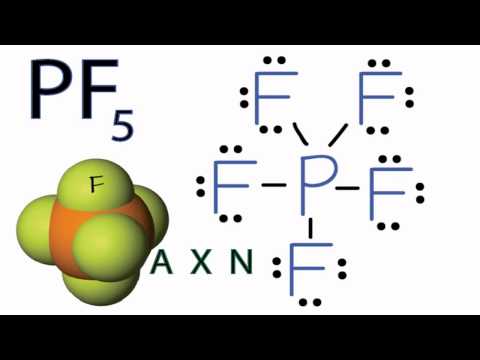
The geometry of PF5 is described as trigonal bipyramidal. This means it has two different types of positions for its fluorine atoms: three in a flat triangle (the equatorial positions) and two above and below this triangle (the axial positions). Imagine standing in a field with your friends forming a perfect triangle around you while two friends hover above you and below—pretty cool, right?
3. Bond Angles Matter
In PF5, the bond angles are about 120 degrees between the equatorial fluorines and 90 degrees between the axial ones. This arrangement helps minimize electron pair repulsion which is essential for stability. If they were too close together, you wouldn’t have a happy molecule!
4. Polarity Considerations
Now here’s an interesting bit—the molecule is nonpolar due to its symmetrical shape! Even though fluorine is super electronegative, the way everything’s arranged balances out any dipoles created by individual bonds. It’s like having a perfectly balanced seesaw; even if one side tries to go down, another pulls it back up.
5. Scientific Implications
Understanding the molecular geometry of PF5 has real-world implications—like in materials science or chemical reactions involving phosphorus compounds. Since PF5 can act as a strong fluorinating agent, knowing how it behaves helps chemists design better reactions for creating various fluoride compounds.
In short, PF5 isn’t just another chemical on the periodic table; it’s like an exciting puzzle with logistical rules! Each insight into its structure tells us more about how molecules interact in our world—and who knows what other secrets these atoms hold?
Understanding the PF5 Bond Angle: Insights into Molecular Geometry in Chemistry
Alright, let’s jump into the world of PF5, which stands for phosphorus pentafluoride. Ever heard of it? Well, PF5 is a cool molecule where one phosphorus atom is surrounded by five fluorine atoms. This setup gives us a perfect chance to talk about bond angles and how they relate to molecular geometry.
First off, bond angles are super important when it comes to understanding how molecules look and behave. The angle between two bonds connected to the same atom can influence everything from chemical reactivity to physical properties. So, with PF5, we’re looking at a structure that creates its own unique bond angles.
The geometry of PF5 is described as trigonal bipyramidal. You might be wondering what that means. Picture the phosphorus atom at the center of a pyramid with two triangular bases on top and bottom—it’s like balancing on a seesaw! The fluorine atoms occupy specific positions around this central phosphorus: three in a plane (the equatorial positions) and two above and below (the axial positions).
- The bond angles in the equatorial plane are 120 degrees.
- The bond angles between an equatorial atom and an axial atom are 90 degrees.
This arrangement helps minimize repulsion between those electron pairs surrounding phosphorus. Like when you’re at a crowded party trying not to bump into people, right? You spread out! The 120-degree angles in the plane allow for more space compared to if they were all squished together.
Interesting enough, if you had different arrangements—let’s say tetrahedral or octahedral—the bond angles would change drastically. With tetrahedral geometry, for instance, you’d have smaller angles at about 109.5 degrees. But that’s not what we’re dealing with in PF5!
You may also find it intriguing that PF5 doesn’t follow the typical octet rule we usually see with carbon or oxygen compounds because phosphorus can expand its valence shell due to available d-orbitals. That’s kind of like having extra shelves in your closet when packing for vacation—you can fit more stuff!
This unique structure affects how PF5 reacts chemically too; it’s known as a good fluorinating agent because those fluorine atoms love to interact with other molecules. So when it comes to understanding molecular geometries like with PF5, you’re really looking at how shape influences behavior in chemistry.
The bottom line is this: Understanding the bond angle and arrangement in molecules like PF5 gives us great insights into their properties and behaviors. Just remember: it’s all about minimizing repulsion while maximizing stability within that funky trigonal bipyramidal shape!
Understanding the PF5 Lewis Structure: Key Insights for Chemistry Enthusiasts
The PF5 molecule is pretty interesting if you’re into chemistry. Let’s unpack the **Lewis structure** of phosphorus pentafluoride together, shall we?
First off, when you look at PF5, you’re dealing with a phosphorus atom bonded to five fluorine atoms. Phosphorus is in group 15 of the periodic table, which means it has five valence electrons. Fluorine, being in group 17, has seven valence electrons but just needs one to fill its outer shell. So, what happens is that phosphorus uses its five valence electrons to form bonds with each fluorine atom.
Building the Lewis Structure:
1. Start by placing phosphorus in the center because it’s less electronegative than fluorine.
2. Around phosphorus, you’ll place the five fluorine atoms.
3. Each F atom will share one electron with phosphorus to make a single bond.
Now you’ve got a clear picture! Each bond consists of two electrons (one from P and one from F), and every fluorine now has a complete octet since they’re sharing those electrons.
Electron Count:
When you count up all the electrons in PF5, you’ve got:
– Phosphorus: 5
– Five Fluorines: 5 x 7 = 35
So, that’s a total of 40 valence electrons! But why does it matter? Well, PF5 is an example of an **expanded octet**. Unlike many elements that are satisfied with just eight electrons around them, phosphorus can handle more due to its ability to use d orbitals for bonding.
Molecular Geometry:
Now let’s talk geometry! The arrangement of atoms around the central atom is crucial for understanding how molecules behave in different situations. For PF5, it adopts a trigonal bipyramidal shape.
Why this shape? Well, in this arrangement:
– Three fluorine atoms occupy equatorial positions (like points on the equator of a globe).
– Two fluorine atoms sit at axial positions (the poles).
This geometry minimizes electron repulsion due to VSEPR theory (Valence Shell Electron Pair Repulsion). It helps keep those negative charges as far away from each other as possible.
Implications of PF5 Structure:
So what does all this mean? Because of its structure:
– **Reactivity:** PF5 can be quite reactive due to the presence of polar bonds between P-F. It’s often used as a fluorinating agent in various chemical reactions!
– **Physical Properties:** The molecular geometry influences boiling point and solubility among other characteristics—PF5 is a gas at room temperature and plays nicely with other reactants.
In summary, understanding the Lewis structure and molecular geometry of PF5 gives us deeper insight into how this compound behaves chemically and physically. Isn’t chemistry just fascinating? You get to see how tiny atoms come together and create something entirely new!
Alright, so let’s chat about PF5, which is phosphorus pentafluoride. Sounds fancy, huh? It actually has a pretty interesting molecular geometry and some implications that are worth thinking about.
So, when we look at PF5, we see that phosphorus is sitting in the center. It’s kind of like the host of a party—there are five fluorine atoms hanging out around it. They’re not just any ordinary guests; they’re seriously electronegative. This means they really like to hog the electrons, which influences how everything is arranged.
PF5 adopts a trigonal bipyramidal shape. If you can imagine it, it’s like two layers of guests at the party—three fluorine atoms on an equatorial plane (like a round table) and two more sitting above and below (the VIPs). This arrangement helps minimize repulsion between the bonded pairs of electrons. Quite slick if you think about it!
I remember learning this in my high school chemistry class and feeling like I was discovering a new world. It struck me that this wasn’t just a bunch of random atoms crashing together; there was an actual structure to it! Like how different people fit into different roles at a gathering—it was all about balance and space.
Now, why does this matter? Well, the geometry affects reactivity and properties. For instance, PF5 can act as a powerful fluorinating agent in organic synthesis. Imagine having something that could tweak molecules by adding fluorine groups—it opens doors to creating new materials or compounds! Whether you’re looking for something to enhance battery technology or improve pharmaceuticals, understanding PF5’s structure gives chemists valuable insights into how to manipulate reactions.
So yeah, diving into molecular geometry isn’t just academic; it has real-world implications. Seeing how these tiny structures can influence big ideas is one of those moments when science feels connected to life in such cool ways. The next time you mix things up in your kitchen or tinker with your devices, remember: even at the tiniest levels, there’s so much going on!