You know those moments when you’re in a chemistry class, and the teacher starts talking about molecular shapes? It feels like you’re lost in geometry class all over again, right? Like, seriously, who thought we’d be figuring out triangles and angles with molecules?
Well, here’s a fun fact: The shape of a molecule can totally affect how it behaves. Yeah, it’s true! Take sulfur dichloride (SCl2), for example. This little guy has a very specific shape that’s super important in chemistry.
Understanding its geometry can help explain so much about its reactions and properties. And honestly, who wouldn’t want to know why? So let’s chat about SCl2 and see why its shape matters—because trust me, it’s wilder than it sounds!
Understanding Molecular Geometry: Its Importance and Impact in Chemistry and Science
Molecular geometry is one of those cool aspects of chemistry that kind of shapes everything around us. When you think about it, it’s all about how atoms come together in space to form molecules. The shape a molecule takes can tell us so much about its reactivity and properties. Take sulfur dichloride (SCl2), for example. The molecular geometry here is really interesting!
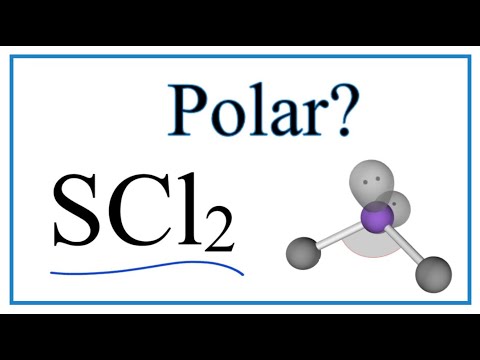
So, SCl2 has a *bent* shape, which is crucial for a couple of reasons. First off, the central atom—sulfur—has two chlorine atoms attached to it. Imagine connecting two kids with a string while standing on a skateboard; the way they pull you off balance represents the angles formed by those bonds. In SCl2, the angle between the two S-Cl bonds is about 103 degrees. This bent shape results from lone pairs of electrons on sulfur pushing down on those bonds. It’s like they’re saying, “Hey, we need some space!”
Now, why does this matter? Well, let’s look at **polarity**! Since chlorine is more electronegative than sulfur, it pulls the bond electrons closer to itself. This creates a partial negative charge near the chlorines and a partial positive charge near sulfur. Because of that bent geometry, SCl2 becomes a polar molecule overall. Polarity affects how molecules interact with each other. For instance, polar molecules tend to be soluble in water (a polar solvent), whereas nonpolar molecules usually aren’t.
Another important aspect here is **reactivity**! The shape influences how SCl2 reacts with other substances. In many chemical reactions, molecules need to collide in just the right way to react effectively—a concept known as collision theory. If SCl2 had a linear shape instead of bent—like carbon dioxide (CO2)—it wouldn’t interact as effectively with other polar substances.
Understanding molecular geometry also extends beyond just one molecule. It helps chemists predict and explain behaviors of countless chemical compounds! When you grasp these shapes and angles across different molecules—like methane (CH4) being tetrahedral or ammonia (NH3) being trigonal pyramidal—you start seeing patterns that can predict complex behaviors in chemical reactions.
So yeah, molecular geometry isn’t just about shapes; it’s fundamental to understanding chemistry at its core! It connects structure with function and impacts everything from melting points to reaction rates to solubility and more. Essentially, by understanding how these atoms arrange themselves in three dimensions, you’re unlocking insights into why they behave the way they do in our world.
All in all, if you ever find yourself mixing chemicals or cooking up experiments in your kitchen—remember that behind every reaction lies an invisible world of molecular geometry shaping outcomes! Isn’t science just magical?
Understanding the Significance of Hybridization in Molecular Geometry: Implications for Molecular Science
Alright, let’s break down this whole idea of hybridization and how it ties into molecular geometry, especially focusing on that funky molecule SCl2.
First off, **hybridization** is a way that atoms can mix their orbitals to form new ones. Imagine you have different colors of clay—when you mix them, you get a whole new color. That’s what happens with atomic orbitals! It helps to create shapes that molecules adopt to minimize energy and maximize stability.
Now, when we look at **SCl2** or sulfur dichloride, we get to see hybridization in action. Sulfur (S) is the central atom here, and it has six valence electrons. When sulfur bonds with two chlorine (Cl) atoms, something interesting happens. In order to bond effectively, sulfur undergoes sp³ hybridization. This means it mixes one s orbital and three p orbitals to create four equivalent sp³ hybrid orbitals.
So why do those orbitals matter? Well, because they determine the shape of the molecule! For SCl2, there are two single bonds with chlorine atoms and two lone pairs of electrons left over on sulfur. The presence of these lone pairs influences the overall geometry.
Now here’s where it gets a bit technical but hang tight! The molecular geometry of SCl2 can be described as bent or angular. So instead of forming a straight line (which would be linear), the molecule bends due to those lone pairs pushing down on the bonded atoms. This bending is essential because it affects how the molecule interacts with other substances.
Also important is how this impacts **polarity**. The bent shape means SCl2 has regions with different electric charges—a positive side near sulfur and negative sides near the chlorines—making it polar. That has real implications in chemistry; for example, polar molecules tend to dissolve well in water but struggle with nonpolar substances like oils.
Here are some key points about why understanding hybridization matters:
- Molecular Shape: Helps predict how molecules will behave in reactions.
- Reactivity: Polar vs nonpolar interactions change how substances mix or react.
- Predictive Power: Knowing geometry allows chemists to anticipate properties like boiling points and solubility.
So whenever chemists study molecules like SCl2 or discuss hybridization, they’re not just playing around—they’re diving into some serious implications for everything from chemical reactions to environmental chemistry. Hybridization helps us understand why things are shaped the way they are and what that means for their behavior in the world around us!
Understanding SCl2 in Chemistry: Properties, Structure, and Applications
Understanding SCl2 in Chemistry: Properties, Structure, and Applications
So, let’s talk about SCl2, or sulfur dichloride. This molecule is kind of interesting because it’s not just your everyday compound. You can find it hanging out in different chemical reactions and even in some industrial processes.
Properties of SCl2
First off, it’s a pale yellow liquid with a rather pungent smell. If you’ve ever caught a whiff of something chlorinated, you sort of know what I’m talking about. It has a boiling point of around 59 degrees Celsius, which means it can easily turn into gas at room temperature if given the chance.
Now, chemically speaking, SCl2 is classified as a **covalent compound**. What this means is that the sulfur atom shares electrons with two chlorine atoms to form the molecule. It’s a little like sharing your favorite snack with friends; but here, they’re sharing electrons instead!
Molecular Geometry
When we look at the **molecular geometry** of SCl2, things get interesting! The molecule takes on a **bent shape**, which is due to the lone pairs of electrons that sulfur has on its outer shell. Picture this: The chlorine atoms are like two friends sitting on either side of another friend (the sulfur), but there’s also an invisible friend—the lone pair—pushing everything down.
You might think this bent shape is just for looks, but it’s actually super important! It influences how the molecule interacts with other substances and determines its polarity—basically whether it’s more like water or oil.
Applications
Now onto where this stuff gets used! SCl2 isn’t just sitting around looking pretty; it has practical applications as well:
- Synthesis: It’s often used in organic synthesis to create other compounds.
- Pesticides: Some formulations for pest control make use of sulfur dichloride.
- Sulfur Sources: In some processes, this compound provides sulfur for various chemical reactions.
Each of these applications shows just how versatile SCl2 can be in the lab or industrial settings!
Toxicity Warning!
But here’s where we need to be cautious: SCl2 can be quite toxic if mishandled. That strong smell I mentioned? Yeah, that’s because it’s harmful in high concentrations. So if you’re ever around it or something similar in a lab setting—safety first!
So there you have it! From its properties and structure to its real-world applications, SCl2, while sometimes overlooked, plays an essential role in various chemical processes that help shape our world today. Isn’t chemistry amazing?
So, let’s talk about SCl2, or sulfur dichloride, if you wanna get all formal about it. Now, when we think about molecules, we usually picture them as these little clusters where atoms hang out together. In the case of SCl2, you’ve got a sulfur atom bonded to two chlorine atoms. Seems pretty simple, right? But the geometry of this molecule is what makes it interesting!
You see, SCl2 doesn’t just sit there in a perfect line like some molecules do. Instead, it adopts a bent shape—kind of like when you’re trying to look around someone at a concert or something. This angle between the chlorine atoms is crucial because it affects how the molecule interacts with other molecules and substances around it. It’s all about that spatial arrangement!
Thinking back to my chemistry class—a long time ago—I remember staring at those angles in diagrams and feeling lost sometimes. But then one day during lab practicals, we mixed some SCl2 with water and got this cool reaction that made everyone’s eyes widen. We could actually see how the shape mattered in real-time! The bent structure allowed the sulfur dichloride to react differently compared to something linear.
Now, why should you care about molecular geometry? Well, it’s not just for showing off in chemistry classes; knowing how molecules are shaped helps chemists predict reactions and understand properties of substances! For example, that bent geometry creates a polar molecule which can lead to interesting behaviors like solubility in different solvents or even interactions with biological systems.
It’s like having a secret code for how things behave at the microscopic level. So next time you hear about geometry in chemistry—or maybe you’re stuck on those diagrams again—just think about how much impact those angles and shapes really have on everything around us! Isn’t that kind of mind-blowing?